
 English
 русский
 Türk
TürkКонтент
A printed circuit board moves along a brushing station in an electronics plant. A nylon brush spins at 3,000 rpm to remove dust and flux residue. Every contact generates static charge on the bristles, and with the wrong material, that charge discharges directly into the board. The damage is intermittent, hard to trace, and expensive. This is why ESD safe material has moved from a specialty niche to a standard specification for brush filaments used in electronics, cleanroom, and precision manufacturing. Choosing the right static-dissipative filament requires understanding resistivity, base resins, and additive loading, not just checking a label on a datasheet.
What Does ESD Safe Material Mean?
An ESD safe material is a plastic compound formulated to control electrostatic charge. The conclusion first: it does not prevent static from being generated, it prevents charge from building up to the point where a discharge can occur. This is achieved by giving the material a surface resistivity low enough to allow slow dissipation, but high enough to avoid leakage currents that disturb low-voltage electronics. The industry measures this property in ohm/sq, and the classification system is consistent across most international standards.
Surface Resistivity Classifications
| Classification | Surface resistivity (ohm/sq) | Typical use |
|---|---|---|
| Conductive | < 10 5 | Shielding, grounding brushes |
| Static-dissipative | 10 5 to 10 11 | Brush filaments, work surfaces |
| Antistatic | 10 9 to 10 12 | Packaging, trays, films |
| Insulating | > 10 12 | Standard plastics, avoid in ESD zones |
The chart above compares the surface resistivity ranges used to classify ESD materials across the industry. Conductive materials, below 10 5 ohm/sq, allow charge to move almost freely and are commonly used in grounding components. Static-dissipative materials fall between 10 5 and 10 11 ohm/sq, the range preferred for brush filaments because they release charge at a controlled rate. Antistatic materials overlap the upper end of this range and mostly prevent triboelectric charging rather than actively conducting it. Insulating materials above 10 12 ohm/sq trap charge on the surface, so they are excluded from ESD controlled areas. This is why most brush filament suppliers target the static-dissipative band around 10 6 to 10 9 ohm/sq, and it is the first specification you should verify when sourcing any ESD safe material.
Why Brush Filaments Need ESD Safe Properties
Brush filaments contact surfaces continuously, and contact is the main cause of triboelectric charging. Ordinary nylon and PBT filaments are insulators, so every brushing pass accumulates charge on the bristle tips. When the brush approaches a grounded component or a sensitive circuit, the potential difference discharges as a spark. Even small sparks damage semiconductor junctions, corrupt memory chips, and raise field failure rates in ways that final inspection rarely catches.
The fix is to compound the base polymer with a conductive additive, most commonly carbon black. The additive forms a microscopic network inside the filament, allowing charge to flow along the bristle and through the brush hub to ground. This is the same principle used in conductive plastic brush filaments installed on PCB cleaning lines and battery production equipment. Real application examples of conductive plastic brush filaments show how material choice affects process yield, so they are worth reviewing before you specify a compound.
Typical brushing applications that require ESD safe material include:
- PCB cleaning and flux removal after soldering
- Dust removal from camera modules and display panels
- Deburring plastic housings without attracting debris back to the surface
- Brush rollers on automated conveyors for battery and semiconductor trays
In all these cases, the filament must dissipate charge in milliseconds, not accumulate it for seconds. The practical target is a surface resistivity of 10 6 to 10 9 ohm/sq, which sits in the lower half of the static-dissipative band.
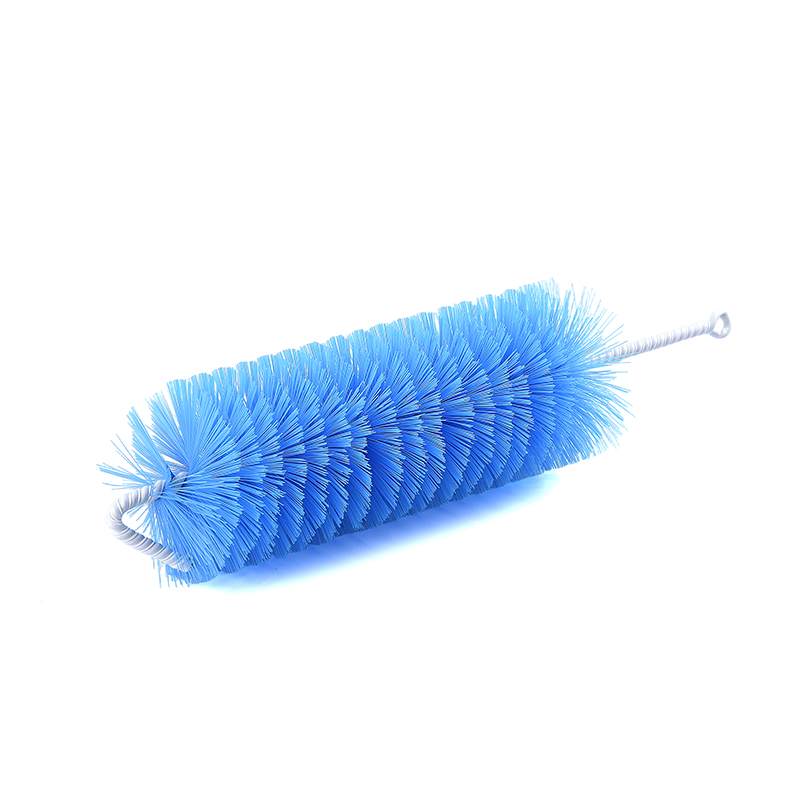 Nylon PA610 Brush Filament Nylon PA610 is a high-performance nylon material that is widely used in many fields due to its unique physical and chemical properties. Nylon PA610 has a series of per... View Product →
 Base Resins for ESD Safe Brush Filaments
The base resin determines everything except the conductivity. Mechanical strength, wear resistance, chemical compatibility, and, critically, how much the resistivity drifts with humidity, all come from the polymer itself. The table below compares the five most common filament resins supplied by brush material manufacturers.
| Property | PA6 | PA66 | PA610 | PA612 | PBT |
|---|---|---|---|---|---|
| Water absorption at saturation (%) | 9.5 | 8.5 | 3.3 | 3.0 | 0.4 |
| Melting point (°C) | 223 | 260 | 220 | 218 | 224 |
| Tensile strength (MPa) | 75 | 85 | 60 | 55 | 57 |
| Resistivity stability in humidity | Poor | Poor | Good | Good | Excellent |
This column chart shows why base resin selection matters for ESD safe brush filaments. Water absorption directly affects surface resistivity, because absorbed moisture creates an additional conductive path that shifts the material away from its designed ESD window. PA6 and PA66 absorb more than eight percent water at saturation, which makes their electrical properties change noticeably with ambient humidity. PA610 and PA612 reduce that absorption to about three percent, so their ESD performance is more stable across seasons and climates. PBT absorbs less than half a percent, making it the most dimensionally and electrically stable option in humid production environments. For applications where consistent static dissipation matters more than raw strength, a low moisture resin such as PA612 or PBT is usually the safer choice.
For ESD safe materials, water absorption is not a side issue. Absorbed moisture creates an unplanned conductive path on the filament surface, shifting the effective resistivity downward as humidity rises. A filament that measures 10 8 ohm/sq in a dry warehouse can measure below 10 6 ohm/sq in a humid plant, which changes its ESD classification entirely.
The practical conclusion is to select a resin with low moisture uptake when the operating environment is not climate controlled. PA610 and PA612 are the industry workhorses because they balance wear resistance with moisture tolerance. PBT goes further and is the best choice for dimensional precision and stable dissipation, although it is stiffer than nylon and slightly more brittle under repeated flexing.
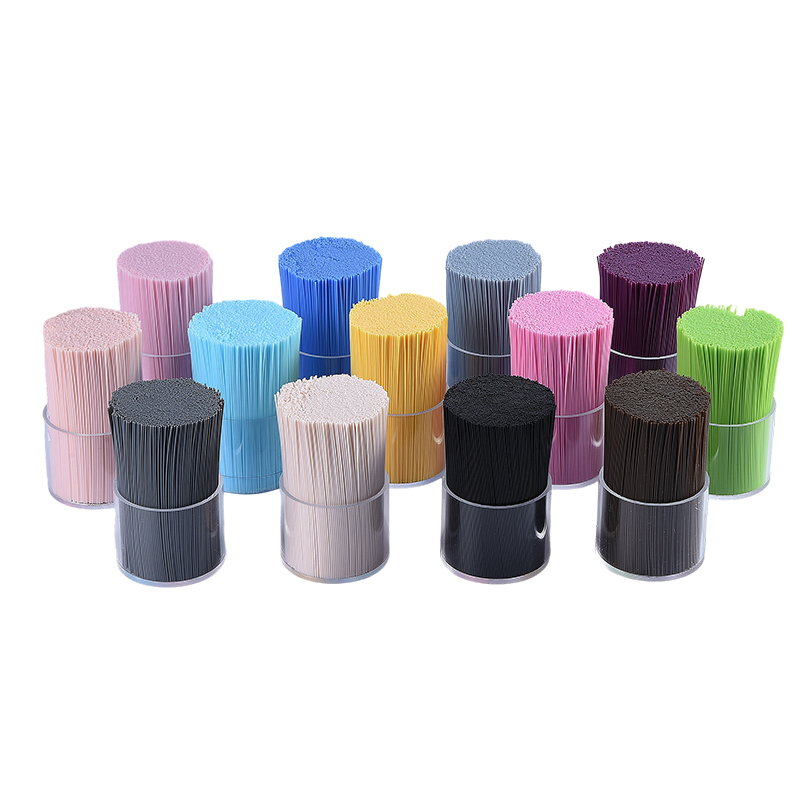 Nylon PBT Brush Filament Nylon PBT, full name polybutylene terephthalate, is a thermoplastic engineering plastic that combines the advantages of nylon (PA) and PBT (polybutylene terephthalate)... View Product →
 How Carbon Loading Shapes Resistivity
The relationship between additive content and electrical performance is not linear, and this is the most common source of confusion in the market. A small increase in carbon black loading can swing resistivity by several orders of magnitude. The chart below shows a representative curve for carbon black filled nylon filament; the same general shape applies to PBT and other base resins.
This line chart shows a characteristic percolation curve for carbon black filled nylon, and the shape explains a lot about ESD safe material behavior. At low additive loadings, the carbon particles are too far apart to form a continuous network, so the resistivity stays close to the pure polymer. When the loading reaches roughly five percent, the particles begin to touch and the resistivity falls by several orders of magnitude within a narrow window. That sharp drop is the percolation threshold, and it means small variations in dosing can cause large swings in ESD performance. Beyond the threshold, additional carbon has diminishing returns, so manufacturers deliberately specify loadings slightly above the steepest part of the curve. This is why a compounding supplier with consistent batch to batch quality matters more than the nominal resistivity value printed on a datasheet.
For a buyer, this curve has a direct consequence. A supplier that claims ESD safe material without specifying a resistivity range, or that does not control batch uniformity, can deliver filaments that pass incoming inspection one month and fail the next. The acceptable window for brush filaments in electronics lines is roughly 10 6 to 10 9 ohm/sq, and the compound must stay inside this window after extrusion, drawing, and conditioning.
Comparing ESD Safe Material Candidates
When a brush manufacturer compares material options, the decision is rarely between conductive and non-conductive. It is almost always a trade-off between two different ESD safe filament families. The radar chart below compares carbon filled PA612 and carbon filled PBT for brushing applications across six criteria, based on typical technical datasheet values and field experience.
The radar chart compares two commonly specified ESD safe material candidates for brush filaments, both using conductive carbon black in different base resins. PA612 offers better wear resistance and mechanical flexibility, which matters when the filament runs against sharp edges or high speed fixtures. PBT wins on dimensional stability and humidity tolerance because its low moisture absorption keeps resistivity steadier in uncontrolled shop floor conditions. Neither resin shows a clear advantage in ESD stability alone, because the additive system, not the base polymer, determines the final resistivity range. The real decision therefore depends on the brushing process: aggressive surface finishing favors PA612, while cleanliness and precision favor PBT. This is why a supplier offering both material families, rather than a single compound, gives procurement teams a genuine choice.
The comparison explains why more than one ESD safe material should be qualified. If the brushing process involves high-speed contact with metal edges, PA612 filament resists wear and remains flexible. If the process operates in high humidity or requires tight dimensional control for brush combs, PBT is the more predictable option.
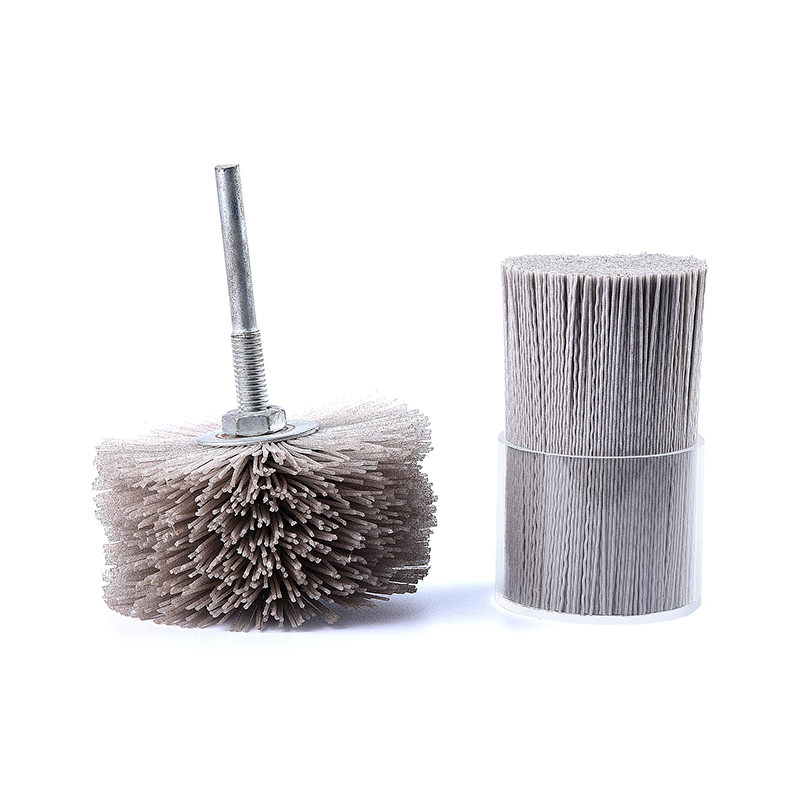 Nylon PA612 Brush Filament Nylon PA612, also known as polyamide 612, is an important variety of polyamide engineering plastics with unique physical and chemical properties. Nylon PA612 has chemi... View Product →
 Practical Considerations When Sourcing ESD Safe Material
Six checks reduce the risk of buying the wrong material:
- Ask for a surface resistivity range, not just the label ESD safe. The range should be tested at a defined relative humidity, typically 50 percent, and at room temperature.
- Confirm that the conductivity is volumetric, meaning the additive is mixed through the filament rather than coated on the surface. Surface coatings wear off after a few hours of brushing; volumetric conductivity lasts for the life of the brush.
- Check the abrasion behavior of the carbon filled compound. Carbon black can deposit on light-colored workpieces, and for optical parts this marking is usually unacceptable.
- Review compliance documentation, including RoHS and SGS test reports, and verify the batch number on each lot.
- Request samples and measure resistivity after bending, knotting, and soaking in the process solvent. Processing can damage the conductive network in some compounds.
- Work with a supplier that can adjust the formulation to your target resistivity instead of accepting a fixed off-the-shelf grade.
Custom compounding is where a brush filament supplier with in-house production shows real value. A factory that controls both the base resin and the additive dosing can iterate quickly, document batch behavior, and deliver filaments matched to the customer's drawing and performance requirements.
A quick summary. ESD safe material for brush filaments means a static-dissipative plastic, usually a selected grade of nylon or PBT, compounded with carbon black to reach roughly 10 6 to 10 9 ohm/sq. The base resin sets mechanical and humidity behavior, the carbon loading sets electrical behavior, and the supplier's process consistency determines whether both remain stable in real production. When these three factors are aligned, the filament protects the product and the production line, and that is the real meaning of ESD safe.